Introduction
The Office for Worship has prepared the following guidelines for Extraordinary
Ministers of Holy Communion serving during Sunday Mass, as well as other
Eucharistic celebrations.
The purpose of these guidelines is to provide some general observations
and principles on this important ministry of the Church. For a smooth
functioning of this ministry, the needs of the particular faith community
must be taken into account. These guidelines define the contents of the
liturgical law on this matter, the demands of a good Eucharistic liturgy,
and the expectations of the universal and local Church.
Ministry of Holy Communion
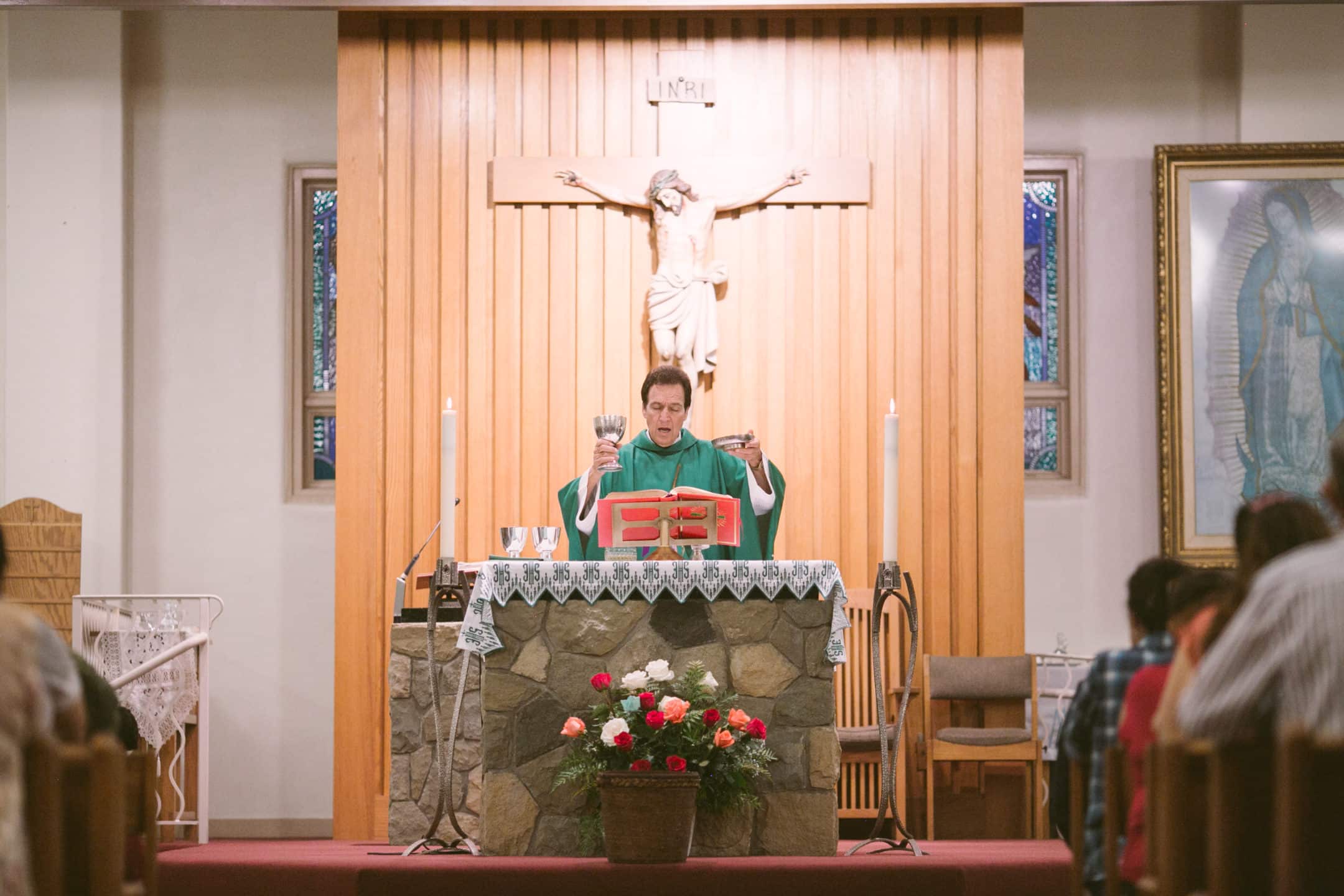
1. The administration of Holy Communion during the Mass is truly a
ministry. It is the ministry of bringing the sacrament of the Body and
Blood of Christ to the People of God. It is also the ministry of witnessing
to faith in the real presence of Christ in the action of sharing in the
Eucharistic meal of Christ’s sacrifice. The ministry of the Eucharist
should, therefore, be treated with utmost dignity and reverence.
2. In every celebration of the Eucharist there should be a sufficient
number of ministers for Holy Communion so that it can be distributed
in an orderly and reverent manner. Bishops, priests, and deacons distribute
Holy Communion by virtue of their office as ordinary ministers of the
Body and Blood of the Lord (Norms for the Distribution and Reception
of Holy Communion Under Both Kinds in the Dioceses of the United States
of America #27).
When the size of the congregation or the incapacity of the Bishop, priest,
or deacon requires it, the celebrant may be assisted by other Bishops,
priests, or deacons. If such ordinary ministers of Holy Communion are
not present, “the priest may call upon extraordinary ministers
to assist him, i.e., formally instituted acolytes or even some of the
faithful who have been commissioned according to the prescribed rite.
In case of necessity, the priest may also commission suitable members
of the faithful for the occasion” (Norms #28; General Instruction
of the Roman Missal #162, 284).
The faculty is granted to pastors and priests chaplains to appoint
extraordinary ministers of Communion in their parishes or institutions.
Requirements
3. Baptized and Confirmed Catholics, fifteen years of age or older,
are eligible for this ministry. They should be persons who sincerely
try to live the Gospel message in their communal and individual lives.
They should faithfully participate in the Sunday Eucharist and with God’s
grace strive to live their faith in every aspect of their lives.
4. Candidates for the ministry of Holy Communion are to be properly
trained before they are commissioned for service in the parish (Norms
#28).
5. All new Extraordinary Ministers of Holy Communion should be commissioned,
preferably during a Sunday Mass. The Rite of Commissioning is found in
the Book of Blessings (chapter 63, page 795 [Catholic Book edition]).
6. The names of newly commissioned ministers are to be submitted to
the Office for Worship so that individual cards noting their commissioning
may be sent for each minister.
7. Extraordinary Ministers of Holy Communion may wear clothing in keeping
with their primary role as members of the assembly.
Concerning the placement and garb of liturgical ministers, a parish
policy should reflect the following values: a) liturgical ministers
are first and foremost members of the worshiping assembly, and should
appear as such; b) flexibility in these areas, in keeping with an attitude
of reverence and service, is desirable (The Day On Which We Gather:
A Pastoral Letter on Sunday Eucharist by Archbishop Roger Mahony,
March 1988, IIC5, p. 16).
8. At least once a year, each community should arrange some program
or retreat to renew the faith, prayer and commitment of the present ministers.
These meetings/retreats could also include discussions of issues that
have arisen in the course of their ministry.
9. All ministers of Communion should be encouraged to attend the Archdiocesan
workshops on liturgy sponsored by the Office for Worship as well as relevant
workshops offered by other Archdiocesan Offices (e.g., Religious Education
Congress).
Procedure During Mass
10. Extraordinary Ministers of Holy Communion ordinarily take their
places within the assembly before the liturgy begins.
All ministers of Holy Communion should show the greatest reverence
for the Most Holy Eucharist by their demeanor, their attire, and the
manner in which they handle the consecrated bread or wine (Norms #29).
11. At the Preparation of the Gifts, the priest prepares the bread
and wine on the altar. If the number of communicants is small, the chalice
should contain an adequate amount of wine for the Communion of all. If
the number is large, one or more flagons of wine are placed on the altar
(in addition to the chalice). The flagons should be of a design and quality
as befits the celebration of the Eucharist.
12. At the Sign of Peace, the ministers of communion enter the altar
area [presbyterium] but remain at a distance from the altar so that the
focus of the assembly is on the breaking of the bread by the presider
[celebrant]. As soon as the Fraction Rite (Lamb of God) Litany begins,
additional chalices may be brought to the altar for filling from the
flagons. (If there are an exceptionally large number of chalices to be
filled, the flagons may be brought to the side table where the chalices
may be filled by a designated minister). In the Archdiocese of Los Angeles,
it is permissible, when necessary, for designated ministers to assist
in the distribution of the consecrated bread from the one ciborium into
additional ciboria and in pouring of the consecrated wine into additional
chalic es.
This action is usually carried out at the altar, so that the sharing
of all from the one cup is signified; in the case of large assemblies,
it may be done at the side table within the area around the altar (presbyterium)
(Norms #37).
13. The priest presider [celebrant] receives Communion first. After
the priest has received Communion, he distributes Communion under both
kinds to the assisting deacon, if present. Then Communion under both
kinds may be given to the ministers by the priest, assisted by the deacon
who ordinarily distributes the Blood of the Lord. (NB: If the whole assembly
is not being offered the Blood of the Lord, it is not appropriate to
offer it to the ministers only).
The practice of Extraordinary Ministers of Holy Communion waiting to
receive until after the distribution of Holy Communion is not in accord
with liturgical law (Norms #39).
As the priest or deacon approaches the minister with the Body or Blood
of the Lord, the minister bows his or her head as a sign of reverence
and responds with a clear “Amen” to the invitation, “The
Body of Christ” or “The Blood of Christ.” Next, a vessel
containing the Body or Blood of the Lord is handed by the priest or deacon
to each minister, and he/she goes to the respective station for the distribution
of Communion to the assembly (Norms #38-40).
14. Since enough bread and wine for each assembly’s Eucharist
is brought forward at the time of the Preparation of the Gifts, the need
to go to the tabernacle is avoided.
The General Instruction of the Roman Missal states, “It is most
desirable that the faithful, just as the priest himself is bound to do,
receive the Lord’s Body from hosts consecrated at the same Mass
and that, in the instances when it is permitted, they participate in
the chalice (cf. no. 283), so that even by means of the signs Communion
will stand out more clearly as a participation in the sacrifice actually
being celebrated” (85). Further supporting this understanding is
the fact that the GIRM makes no mention of bringing the ciborium(a) with
hosts consecrated at an earlier Mass to the altar during the Eucharistic
Celebration.
However, if the ministers of the Body of Christ realize that they do
not have sufficient hosts for the number of communicants, a minister
(e.g., the Master of Ceremonies or one of the Ministers of Communion)
should be ready to go to the tabernacle and bring the ciborium(a) to
the Ministers of Communion who do not have sufficient hosts.
In the Archdiocese of Los Angeles, extraordinary ministers may assist
the ordinary ministers in handing the vessels to others for the distribution
of Holy Communion.
Distribution of the Body of Christ
15. The Body of Christ (Communion under the form of bread) is administered
with the words: “The Body of Christ.” After the communicant
has responded “Amen,” the (consecrated) bread/host is placed
in the hand or on the tongue according to the manner indicated by the
communicant. (The communicant may choose whether to receive the Body
of Christ in the hand or on the tongue.) (Norms #41).
“When receiving Holy Communion, the communicant bows his or her
head before the Sacrament as a gesture of reverence and receives the
Body of the Lord from the minister….When Holy Communion is received
under both kinds, the sign of reverence is also made before receiving
the Precious Blood” (GIRM #160).
16. The Body of Christ is always ministered to the communicant. Communicants
are not permitted to take their own consecrated bread/hosts and communicate
themselves.
17. If a host/piece of consecrated bread falls to the ground during
distribution, the minister Revised November 2003 4 should pick it up,
place it in the ciborium, and consume it after the distribution is over.
18. If someone who is not receiving Communion comes in the Communion
Procession to the minister of the Body of Christ, the minister may offer
a simple greeting, e.g., “May Jesus be with you always.” Especially
in the case of children, the minister may gently touch the person’s
head. Words or gestures of blessing should be avoided.
19. After the distribution of Communion, if the number of hosts is not
too great and providing that there are sufficient hosts in the tabernacle
to provide for Communion to the sick, the remaining hosts should be reverently
consumed by the ministers of Communion at a side table or in the sacristy.
If the number of hosts remaining is great, they are reserved in the tabernacle.
Care should be taken with any fragments remaining on the corporal or
in the sacred vessels (Norms #51).
NB: In preparing the unconsecrated bread before the Liturgy prudence
should be exercised to insure that the number of hosts consecrated corresponds
to the number of communicants to be expected at the Liturgy.
20. The ciboria which held the hosts should be placed on a side table
or taken into the sacristy. Ordinarily they should be placed on a corporal
and suitably covered. Ideally, they are cleansed immediately following
the Liturgy by the designated ministers. However, the ciboria may be
cleansed immediately following the distribution of Communion (Norms #53).
Communion from the Chalice
21. In the Archdiocese of Los Angeles, Communion under both kinds,
the Body and Blood of Christ, is normative on Sundays and holy days – as
well as at weekday Masses. In order to insure that this is done in a
reverent and orderly manner, the availability of sufficient ministers
is essential. Also, ongoing catechesis on the theological and liturgical
aspects of this practice is important. The freedom of each communicant
to choose or not to choose Communion under both kinds should be stated.
If a person is unable to receive Communion under the form of bread, he/she
may choose to receive Communion under the form of wine – the Blood
of Christ (Norms #24, 25, 46).
Holy Communion has a fuller form as a sign when it is distributed
under both kinds. For in this form the sign of the Eucharistic banquet
is more clearly evident and clear expression is given to the divine
will by which the new and eternal Covenant is ratified in the Blood
of the Lord, as also the relationship between the Eucharistic banquet
and the eschatological banquet in the Father’s Kingdom (GIRM
#281).
So that this “fuller light” may foster the faithful’s
greater participation in the mystery, Communion under both kinds is
to be desired in all celebrations of the Mass, although this is not
possible in all cases. For in this sacred rite “the sign of the
eucharistic meal stands out more explicitly”, and the act of
drinking the consecrated wine, the Blood of Christ, strengthens the
faith of communicants in the sacrificial nature of the Mass.
Communion under both kinds can therefore manifest more fully the nature
of the Mass as a sacrifice and as a sacred banquet, ritually expressing
that “the sacrifice and the sacred Meal belong to the same mystery,
to such an extent that they are linked to one another by a very close
theological and sacramental bond” (This Holy and Living Sacrifice:
Directory for the Celebration and Reception of Communion under Both
Kinds #19).
It is the choice of the communicant, not the minister, to receive
from the chalice (Norms #46).
22. When the members of the assembly drink from the chalice, ordinarily
there should be two ministers of the chalice for each minister with the
ciborium; but each community needs to determine what ratio is most suitable.
Ministers should stand an appropriate distance from each other to facilitate
the Communion procession and not unduly impede the assembly’s easy
movement.
Ministration of the Chalice (The Blood of Christ)
23. The chalice is offered to the communicant with the words, “The
Blood of Christ,” to which the communicant responds, “Amen.” Generally,
the communicant should hold the chalice firmly in both hands and drink
from it. However, in the case of physical disability or weakness, the
minister should be ready to assist in holding the chalice.
24. After each person has received the Blood of Christ, the minister
should wipe both sides of the rim of the chalice with a purificator and
turn the chalice slightly before repeating the procedure for the next
communicant.
25. Any danger of spilling the Precious Blood should be carefully avoided.
If, by chance, the wine should spill, the area should be marked, covered
immediately and washed after Mass.
26. The chalice may never be left on the altar or another place to
be picked up by the communicant for self-communication (except in the
case of concelebrating bishops or priests), nor may the chalice be passed
from one communicant to another (Norms #44).
27. Following the distribution of Communion, the ministers of the Eucharist
consume the remaining Precious Blood from their chalices at a side table
or in the sacristy (except as noted below, #28). The ministers of the
Body of Christ or other appropriate people may be asked to assist in
the consumption of the Precious Blood if needed. The chalices and other
vessels that held the Precious Blood are placed on the side table or
taken into the sacristy. Ordinarily, they should be placed on a corporal
and suitably covered. Ideally, the designated ministers cleanse the chalices
and other vessels in the sacristy immediately following the conclusion
of the Liturgy. However, all the vessels may be cleansed following the
distribution of Communion (Norms #52-53).
28. The Precious Blood may not be reserved, except for giving Communion
to someone who is sick and who is unable to receive Communion under the
form of bread. The Blood of the Lord is kept in a properly covered vessel
and is placed in the tabernacle after Communion. The Precious Blood should
be carried to the sick in a vessel that is closed in such a way as to
eliminate all danger of spilling. If some of the Precious Blood remains
after the sick person has received Communion, it should be consumed by
the minister, who should also see to it that the vessel is properly purified
(Norms #54).
29. The reverence due to the Precious Blood of the Lord demands that
it be fully consumed after Communion is completed and never be poured
into the ground or the sacrarium (Norms #55).
It should be remembered that all movements in the liturgy must be carried
out with dignity and reverence. Liturgical movements are never hurried.
Communion by Intinction
30. Communion by intinction, that is, by dipping the host into the Precious
Blood is legally allowed. However, since it eliminates the communicant’s
legitimate option to receive Communion in the hand, and also denies the
right of the faithful to receive Communion under the form of bread only,
intinction is not recommended.
Because of its ancient sign value “ex institutione Christi,” Communion
from the cup or chalice is always to be preferred to any other form
of ministering the precious Blood (This Holy and Living Sacrifice #44).
31. If a community still chooses Communion by intinction, the following
should be remembered:
a. The formula to be used by the minister is: “The Body and Blood
of Christ.” After the communicant responds, “Amen,” the
dipped host is placed on the tongue. b. The communicant is not allowed
to dip his/her own host into the cup. It is dipped and administered to
the individual by the minister.
Children and Communion from the Chalice
32. In the Archdiocese of Los Angeles, Communion under both kinds is
normative at all Eucharistic celebrations and is offered to all who have
received their first Communion. Children are to be prepared catechetically
and liturgically for the option of Communion under both kinds.
Special care shall be given when children receive Communion from the
chalice. Parents should be instructed that Communion under both kinds
is an ancient tradition for children old enough to drink from a cup.
Ideally, children should have some familiarity with drinking wine at
home before they are offered the chalice (This Holy and Living Sacrifice
#49).
Guidelines for Ministers to the Sick
33. Ordinarily each commissioned Extraordinary Minister of Holy Communion
may take Communion to the sick. However, there may be certain specifically
commissioned persons who are sent by the community to minister to the
sick of the parish on a regular basis.
Priests with pastoral responsibilities should see to it that the sick
or aged, even though not seriously ill or in danger of death, are given
every opportunity to receive the Eucharist frequently, even daily,
especially during the Easter Season (Pastoral Care of the Sick:
Rites of Anointing and Viaticum #72).
34. Ideally, ministers to the sick are sent by the parish community
each Sunday to take the Eucharist to those who are prevented from being
present because of age or illness. This is usually done after the Prayer
after Communion. The ministers may be blessed and ritually sent to extend
the unity of the Eucharist with those who are sick. The formula for the
ritual sending may be in these or similar words:
“My brothers and sisters, you are sent to bring the Word of
God and the Bread of Life from this assembly to the sick and shutin
members of our parish family. Go to them with our love and our prayers
in the name of Jesus Christ our Lord” (Liturgical Life 1988,
Vol. II, No. 4, p. 9).
Ministers may be sent in this manner at weekday Masses also.
35. The minister to the sick may celebrate the Communion Service in
one of two ways: a) in context of a liturgy of the Word; b) or in a brief
form for use in more restrictive circumstances (Pastoral Care of the
Sick, chapter 3). It is recommended that whenever possible a group of
sick or aged persons be brought together to celebrate the Liturgy of
the Word and the Communion Service in a communal manner. If this is impossible,
the minister should try to celebrate the Communion Service as fully as
possible depending on the condition of the patient.
36. When the Eucharist is brought to the sick it should be carried in
a pyx or small closed Revised November 2003 7 container. Ideally, a table
is to be prepared with a cloth and a lighted candle for the Eucharist.
A vessel of holy water may also be available.
37. If the sick person can only receive Eucharist under the form of
wine, a container of consecrated wine may be brought from the Sunday
or weekday celebration of the Eucharist. It is to be placed in a properly
covered container and kept in the tabernacle until the minister is able
to take it to the sick person. If any of the Precious Blood remains after
the Communion Service, the minister is to consume what remains and properly
purify the vessel.
38. Those who care for the sick or family members may also participate
in the Communion Service and receive Communion even if they have already
received Communion that day. 39. The pastor or priest-chaplain should
see that worthy Eucharistic containers are available for use by Extraordinary
Ministers to the sick and homebound. The Host is not to be carried in
a handkerchief, envelope or similar unworthy container.
40. It is recommended that Hosts for the sick and homebound be consecrated
in the Mass from which they will be taken and in which the Extraordinary
Ministers have participated. Hosts which cannot be distributed immediately
and consumed at once by the sick and homebound should be consumed by
the minister or returned to the tabernacle.
Viaticum
41. The norm for the reception of viaticum is within the context of
the celebration of Mass with the dying person. However, when this is
not possible due to circumstances and/or the condition of the dying person,
a minister of Holy Communion may distribute viaticum outside of Mass
(Pastoral Care of the Sick, chapter 5).
Conclusion
“Receiving the Bread of Life, the disciples of Christ ready themselves
to undertake with the strength of the Risen Lord and his Spirit the tasks
which await them in their ordinary life. For the faithful who have understood
the meaning of what they have done, the Eucharistic celebration does
not stop at the church door. Like the first witnesses of the resurrection,
Christians who gather each Sunday to experience and proclaim the presence
of the Risen Lord are called to evangelize and bear witness in their
daily lives.” (Dies Domini #45).