The Display of American Flags in Catholic churches
Actually, there are no current regulations specifically governing the
display of flags in Roman Catholic Churches. The decision is left to
the judgment of the diocesan bishop and/or the pastor. In the Archdiocese
of Los Angeles, display of flags is strongly discouraged.
The reasons for not displaying the flag in church come from both the
principles of Catholic worship as well as honor and respect for the American
flag itself.
In the US Bishop’s 1978 document, Environment and Art in Catholic
Worship, display of the flag was explicitly discouraged: “…identifying
symbols of particular cultures, groups, or nations are not appropriate
as permanent parts of the liturgical environment. While such symbols
might be used for a particular occasion or holiday, they should not regularly
constitute a part of the environment of common prayer.” The more
recent bishops’ document, Built of Living Stones, published in
2000, omits specific reference to the flag but repeatedly articulates
the principles that exclude furnishings and articles that are not part
of our worship. We come to worship as Americans, proud of our heritage
and our history, but our focus at Mass is not on our Americanism but
on our faith – our union with Christ. The most important symbols
of our worship are the cross, the bread and the wine, and the gathered
assembly – gathered as the Body of Christ. All other symbols and
elements of the environment should enhance these primary symbols and
emphasize that we gather as the people of God, no matter what our nationality,
political preference, gender, age or background.
In addition to liturgical principles, the US Flag Code states: “When
displayed from a staff in a church or public auditorium, the flag of
the United States of America should hold the position of superior prominence,

in advance of the audience…” Such prominence is not possible
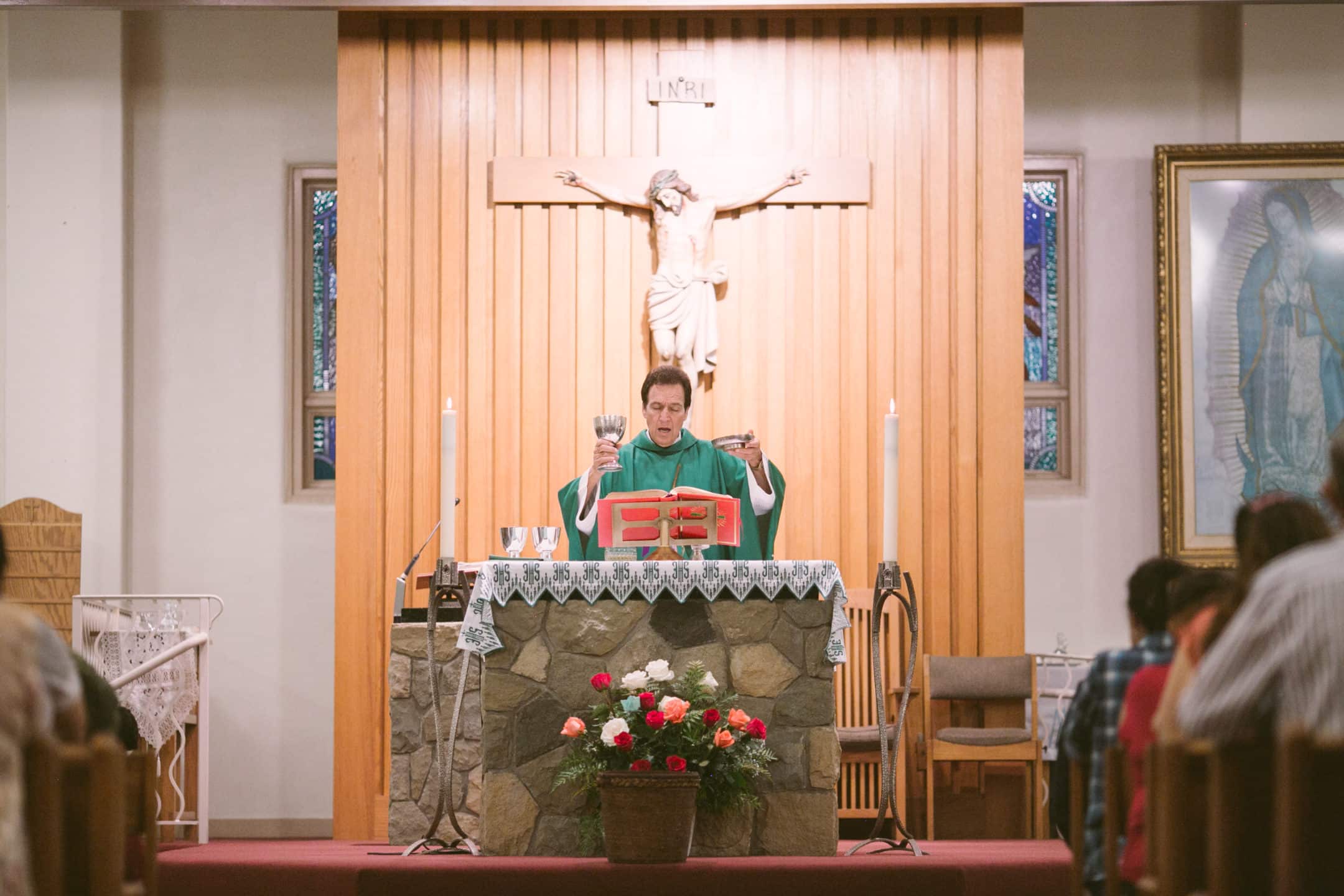
in a Catholic church, where the predominant image is that of the crucified
Christ.
Because of this stipulation, it would be better to give the flag a place
of greater prominence outside of the church in a special area, or perhaps
in the vestibule or gathering space rather than in the main body of the
church.
These principles are similar to those for funerals, in which the flag
is removed from a flag-draped coffin before entering the church, signifying
that we are all one in the Lord and before the Lord. When the body enters
the Church, the pall is placed on the casket as a symbol of the white
baptismal garment - to remind us that the person was baptized into Christ,
and that is what is celebrated at the funeral Mass.
Bread for the Eucharist: Approved Recipes
Bread for the Eucharist is made only of wheat
flour and pure water, without the addition of other ingredients. The
bread can indeed look like real bread. “Following the example of
Christ, the Church has always used bread and wine with water to celebrate
the Lord’s Supper…” The nature of the sign demands
that the material for the eucharistic celebration truly have the appearance
of food.” GIRM # 281-283. (When communities begin using a form
of bread which looks like bread, there might be a bulletin announcement
to address this matter to explain that the recipe being used is in conformity
to the norms established by the Congregation for Doctrine of the Faith.)
The following recipes fulfill the requirements of the Church for eucharistic
bread. These breads are easily broken with very few crumbs. Nine inch
round breads are recommended for Sunday Mass.
Recipe #1
- 2 ½ cups
whole wheat flour
- ½ cup unbleached white flour
- 1 ¼ cups
warm water.
Mix all the ingredients in a bowl. Knead very well for about
6 to 8 minutes, or until the dough is smooth and pliable.
Roll the dough
out into the desired size and shape, to about ¼ inch thick. Prick
around the edge to help prevent the formation of air bubbles. No need
to score.
Bake on a not-stick-baking sheet in a 350-degree oven for about
16-17 minutes depending on the size of the breads. Two 9-inch rounds
can be obtained from this recipe. Cool and wrap in plastic or foil, or
put in a baggie. The bread may then be frozen or refrigerated until needed.
Recipe #2
- 2 ½ cups wheat flour
- ½ cup unbleached white flour
(put flour in freezer ahead of time)
- 1 ¼ cups cold Perrier water
Mixed all the ingredients in a bowl. Knead very well for about 6 to
8 minutes, or until the dough is smooth and pliable. (May use small amounts
of oil on hands to keep from sticking.)
Roll the dough out into the desired size and shape, to about ¼ inch
thick. Prick around the edge to help prevent the formation of air bubbles.
Score bread into ¾ -inch pieces before baking. Bake on a non-stick
baking sheet in a 350-degree oven for about 16-17 minutes, depending
on the size of each bread. Two 9-inch rounds can be obtained from this
recipe. (Cardinal Mahony prefers 7 ½ inch breads for the archdiocesan
stational liturgies). Cool the bread and wrap in foil, or put in a baggie.
The bread may then be frozen or refrigerated until needed.
Recipe #3
For 70 communicants, use ¼ cup whole-wheat flour to 2/3 cup unbleached
white flour. The mixture of flour should be kept in an airtight container
in the freezer and used while cold. (The cold flour helps prevent a separate
crust from forming.)
Use one cup of the flour mixture to approximately ½ cup
of naturally effervescent water (Perrier, for example). The water should
be refrigerator cold.
Quickly mix the flour and water together with a
fork until all the flour is moist. Form dough into a smooth ball. Usually
more flour needs to be sprinkled on the surface of the dough to prevent
stickiness.
Gently flatten the ball of dough into a circular loaf about ½ to ¾ inch
thick. If necessary, turn any uneven edges underneath.
Place un-scored
loaf on a lightly oiled baking sheet.(Use Pam and wipe off excess.)
Place in a preheated oven at 425 degrees.
After approximately 12-15
minutes the top crust should have raised slightly. Pick the crust
with a toothpick in several places, turn the loaf over and continue
to bake about five minutes. (This gives evenness to the top of the loaf.)
Turn the loaf right side up again and continue to bake until the crust
is very lightly browned, about 10-15 minutes more, for a total of
25-30 minutes. Baking time when using more than 1-1/2 cups of flour may
need to be extended.
Resources: Bishops Committee on The Liturgy, The Sacristy Manual
Implementation of Redemptionis Sacramentum in the Archdiocese of Los
Angeles
Cardinal Roger Mahony issued a statement
with guidelines for the implementation of this Instruction within
the Archdiocese of Los Angeles.
Divine Mercy Sunday and Devotions
The Archdiocese of Los Angeles Office for Worship has received many
inquiries regarding Divine
Mercy Sunday and Divine Mercy devotions.
The Essential Celebration of Divine Mercy Sunday consists in the celebration
of the liturgy of
the Second Sunday of Easter during which the homily should focus on the
scriptural readings of
the day. It should be noted that the three cycles of scriptural readings
and the orations are all
centered on the forgiveness of sins and God’s infinite mercy, which
endures forever.
There are also options for enhancement of the celebration. Our response
to inquiries about this
enhancement (i.e. novenas, etc.) is given within the context of the following
statement from
the Constitution on the Sacred Liturgy: "Popular devotions of the
Christian people are to be
highly endorsed, provided they are in accord with the laws and norms
of the Church…. But
these devotions should be so fashioned that they harmonize with the liturgical
seasons, accord
with the sacred liturgy, are in some way derived from it, and lead the
people to it, since in
fact, the liturgy by its very nature surpasses any of them."
When asked about the desirability of beginning the Divine Mercy Novena
on Good Friday in the
parish, for example, the response is to remind the inquirer of the
nature and solemnity of the
most holy Triduum and the primary responsibility of all in the parish
to participate fully in all
the Triduum liturgies. Nothing else should replace or mitigate the
importance and centrality of
these liturgical celebrations. Only when this is assured, might small
groups choose to request to
celebrate novenas and other devotions. Pastors are free to decide whether
or not these will
take place, when and where (in the parish church or in some other place).
For detailed information, please contact Divine Mercy International,
413 298 1184 or John Paul
II Institute of Divine Mercy: 413 298 1189 or email: DivineMerc@aol.com
the following web
site is also helpful: http://www.divinemercysunday.com/
Canon 766 - Lay Preaching
On November 14, 2001, the Latin Church members
of the United States Conference of Catholic Bishops approved complementary
legislation for canon 766 of the Code of Canon Law for the dioceses of
the Latin Church of the United States.
The action was granted recognitio
by the Congregation for Bishops in accord with article 82 of the Apostolic
Constitution Pastor Bonus and issued by decree of the Congregation for
Bishops signed by His Eminence Cardinal Giovanni Battista Re, Prefect,
and His Excellency Most Reverend Franciscus Monterisi, Secretary, and
dated November 27, 2001.
Complementary Norm: Preaching the Word of God
is among the principal duties of those who have received the sacrament
of orders (cc. 762-764). The lay faithful can be called to cooperate
in the exercise of the Ministry of the Word (c. 759). In accord with
canon 766 the National Conference of Catholic Bishops hereby decrees
that the lay faithful may be permitted to exercise this ministry in churches
and oratories, with due regard for the following provisions:
If necessity
requires it in certain circumstances or it seems useful in particular
cases, the diocesan bishop can admit lay faithful to preach, to offer
spiritual conferences or give instructions in churches, oratories or
other sacred places within his diocese, when he judges it to be to the
spiritual advantage of the faithful.
In order to assist the diocesan
bishop in making an appropriate pastoral decision (Interdicasterial Instruction,
Ecclesiae de Mysterio, Article 2 §3), the following circumstances
and cases are illustrative: the absence or shortage of clergy, particular
language requirements, or the demonstrated expertise or experience of
the lay faithful concerned.
The lay faithful who are to be admitted to
preach in a church or oratory must be orthodox in faith, and well-qualified,
both by the witness of their lives as Christians and by a preparation
for preaching appropriate to the circumstances.
The diocesan bishop will
determine the appropriate situations in accord with canon 772§1.
In providing for preaching by the lay faithful the diocesan bishop may
never dispense from the norm which reserves the homily to the sacred
ministers (c. 767§1; cfr. Pontifical Commission for the Authentic
Interpretation of the Code of Canon Law, 26 May 1987, in AAS 79 [1987],
1249). Preaching by the lay faithful may not take place within the Celebration
of the Eucharist at the moment reserved for the homily.
As President
of the United States Conference of Catholic Bishops, I hereby decree
that the effective date of this decree for all the dioceses of the Latin
Church in the United States will be January 15, 2002.
Given at the offices
of the United States Conference of Catholic Bishops in Washington, DC,
on December 13, 2001. Most Reverend Wilton D. Gregory Bishop of Belleville
President, USCCB Reverend Monsignor William P. Fay General Secretary
November 10, 2002 Copyright © by United States Conference of Catholic
Bishops